AI WORKFLOWS
AI-powered end-to-end Product Discovery (7 tested workflows)
Key Tools & Techniques
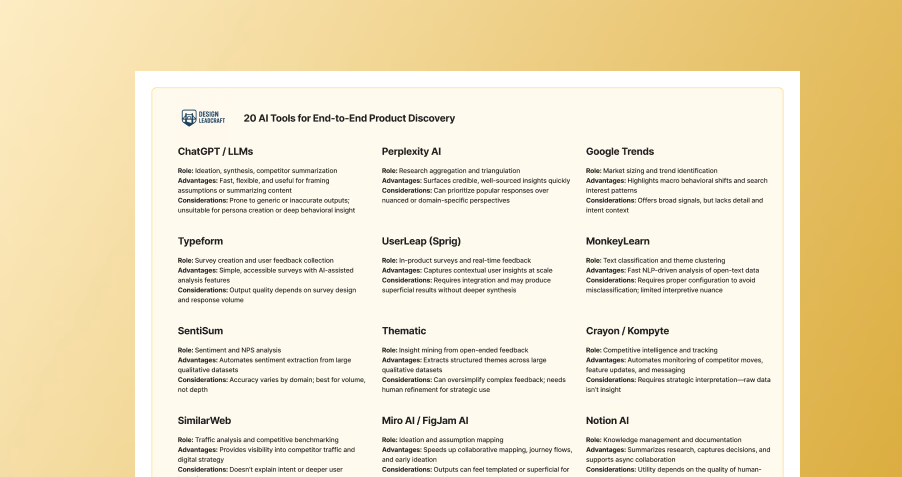
Includes over 20 AI tools I experimented with
01
Challenge
Traditional discovery processes are often linear, fragmented, and siloed—relying heavily on intuition, slow research cycles, and uneven stakeholder alignment.
While AI won't fix poor product thinking, it can supercharge already-strong strategy by enabling:
- Rapid sensemaking across noisy datasets
- More consistent hypothesis validation loops
- Context-rich prioritization decisions
- Lower cost of iteration—without compromising depth
When wielded properly, AI allows a small, cross-functional team to punch far above its weight.
02
7 AI-augmented workflows
Workflow 01
Customer & Market Research
Deep, not just fast
Caution
Personas generated by LLMs based on scraped forum content are often generic, lack behavioral nuance, and reflect second-hand assumptions.
Instead
- Start with behavioral archetypes, built through clustering real usage or support data (e.g., Mixpanel, FullStory), then synthesize manually
- Use AI to aggregate and segment open-ended survey data or public reviews—but synthesize patterns using Jobs-To-Be-Done or behavioral segmentation frameworks.
- Ignore ChatGPT-based persona generation unless you’re pressure-testing assumptions—it’s not a substitute for field research.
Best-in-class tools
- Perplexity for triangulation
- Typeform paired with open-text clustering via MonkeyLearn or LangChain-based pipelines
- GWI market signals
- SparkToro market signals
- Google Trends for directional whitespace mapping
Workflow 02
Pattern & Sentiment Analysis
Surface emergent themes, not noise
Caution
AI can parse thousands of reviews or survey responses—but raw sentiment scoring is rarely actionable.
Instead
- Use AI to surface clusters of thematic friction or unmet needs, then validate with behavioral telemetry or ethnographic data.
- Focus on understanding "why now" triggers, not just positive/negative polarity.
Best-in-class tools
- Thematic
- SentiSum
- NotebookLM
- customized NLP workflows e.g., embedding-based clustering using OpenAI or Cohere APIs
Workflow 03
Competitive Analysis
Contextual, not just scraped
Caution
AI tools can gather competitor data, but real value lies in interpreting product strategy inflection points.
Instead
Don’t settle for feature tables. Use LLMs to summarize shifts in messaging, pricing, or positioning, then map those to strategic moves (bundling, land-and-expand, etc.).
Best-in-class tools
- SimilarWeb
- Crayon
- Perplexity research mode
- Kompyte for trend deltas.
Workflow 04
Ideation & Hypothesis Framing
Think in assumptions, not features
Caution
Generative AI can spark ideas, but experienced teams know that novelty isn’t the same as value.
Instead
- Focus on structuring assumption stacks using LLMs (e.g., “What must be true for X to work?”).
- Map solution hypotheses to the Desirability–Feasibility–Viability triad—then use AI to explore variants.
Best-in-class tools
- Miro AI
- FigJam AI
- Gemini Assistant built in Google Sheets
- Atlassian Rovo built in Jira
- LLM tool with a proper connection to knowledge sources.
Workflow 05
Prototyping & Validation
Speed with substance
Caution
AI-assisted design tools are useful for early flows, but their utility is highest when the interaction model is already well-scoped.
Instead
- Incorporate AI-powered design tools into the iteration loop to quickly generate low-fidelity prototypes.
- Use them to prototype edge cases and alternate flows, not to replace core interaction design.
- Pair with automatic usability feedback loops—but analyze the results through a designer’s eye, not just sentiment charts.
Best-in-class tools
- Figma Make high-fidelity prototypes
- Lovable web apps
- Aura.build web design
- Play native iOS experience
- Cursor
- Google Antigravity.
Workflow 06
Prioritization & Roadmapping
From hunches to scenarios
Caution
Roadmapping isn’t just about what users want—it’s about sequencing for strategic leverage. final prioritization still needs executive judgment grounded in company context.
AI can help
- Score ideas across feasibility, demand signals, and technical risk
- Run “what-if” simulations across different roadmap paths (using your historical data or analogs).
Best-in-class tools
- Productboard
- Dragonboat.
Workflow 07
Team Alignment & Institutional
Learning rather than drowning in documentation
AI can help
- Summarize research synths, workshop outputs, and roadmap decisions into shareable artifacts.
- Generate living knowledge bases to onboard new team members quickly and reduce context debt.
Best-in-class tools
- SlackGPT
- Notion AI.
03
Key Takeaways
The focus shifts from "how to build" to "what to build," as AI handles the heavy lifting of execution, requiring designers to double down on critical thinking, problem-solving, and high-level architectural decision-making
Product designers should evolve into "AI-powered generalists" who leverage LLMs to bridge gaps in technical knowledge, coding, and strategic analysis, thereby expanding their influence beyond traditional UI/UX
AI accelerates the design process by enabling the rapid generation of interactive prototypes and technical documentation, allowing designers to iterate much faster than with manual methods
Rethinking product discovery for the AI era? Let’s talk about what that shift means for your team.